Calling conventions
x86
Let's take another simple example.
main.c
int add(int a, int b)
{
    return a + b;
}


int main()
{
    return add(1, 2);
}
When we call a function in C, the arguments are pushed on the stack.
This can be verified by disassembling the binary obtained from compilating the code.
# compile
gcc main.c -m32 -o main
# disassemble directly in bash
objdump -d -M intel main
Which gives :
00001194 <main>:
    1194:       55                      push   ebp
    1195:       89 e5                   mov    ebp,esp
    1197:       e8 13 00 00 00          call   11af <__x86.get_pc_thunk.ax>
    119c:       05 58 2e 00 00          add    eax,0x2e58
    11a1:       6a 02                   push   0x2          # second argument
    11a3:       6a 01                   push   0x1          # first argument
    11a5:       e8 d3 ff ff ff          call   117d <add>   # call add()
    11aa:       83 c4 08                add    esp,0x8
    11ad:       c9                      leave
    11ae:       c3                      ret
So on the x86 architecture, arguments in a function call are always pushed on the stack, in reverse order.
So that when you actually get inside the function, the stack layout will look like :
pwndbg> stack 20
00:0000│ ebp esp 0xffffd238 —▸ 0xffffd248 ◂— 0x0
01:0004│         0xffffd23c —▸ 0x565561aa (main+22) ◂— add esp, 8
02:0008│         0xffffd240 ◂— 0x1
03:000c│         0xffffd244 ◂— 0x2
04:0010│         0xffffd248 ◂— 0x0
Rule
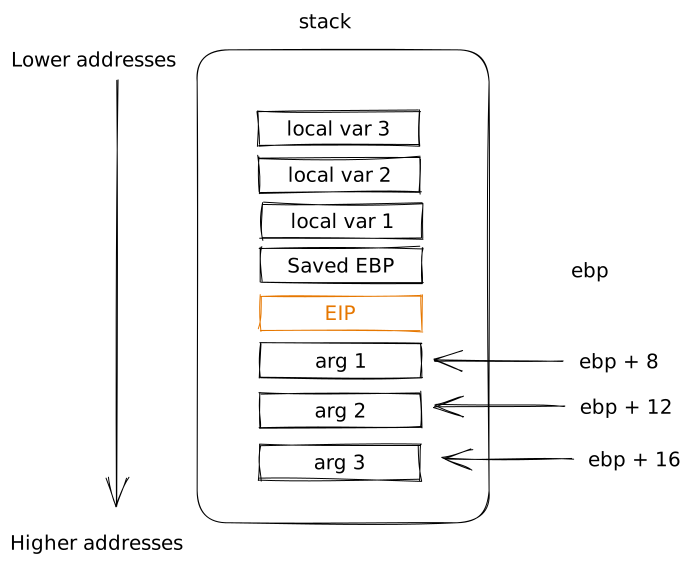
Generally, with a function defined like :
int func(int arg1, int arg2, int arg3)
{
    int local_var1;
    int local_var2;
    int local_var3;
    return arg1 + arg2 + arg3;
}
Your stack layout will look like this when the function starts :